In The Language of Loving: An Essay
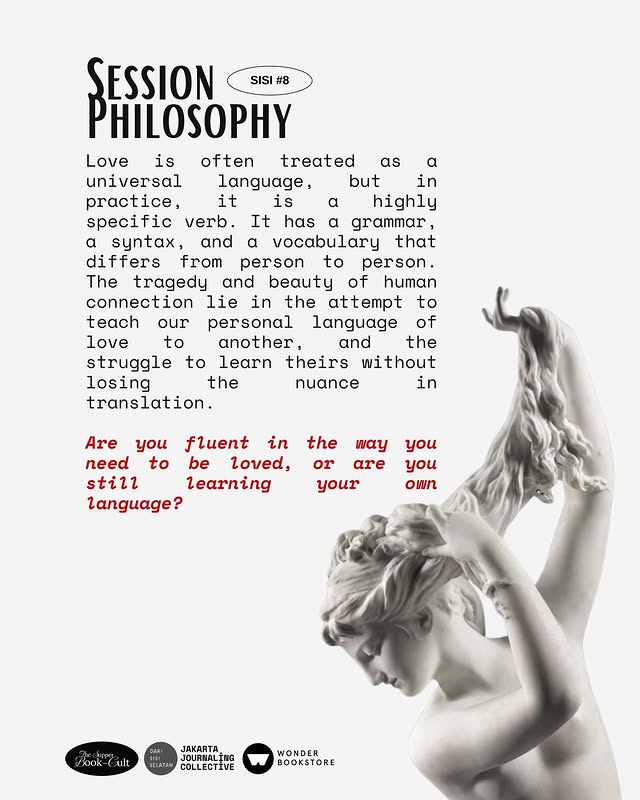
✦ SpotlightOften described as a universal language, a shimmering thing of the heart that supposedly transcends borders and lexicons. Love. Probably the most over-saturated, over-used word in the entirety of human existence. We are taught that to love is to speak a mother tongue we were born knowing. But as we move through the world, bumping our souls against the jagged edges of others, we begin to realize the fallacy of this sentiment. We are told that when the "right" person arrives, the heart will simply recognize its own rhythm in another. But if love is a language, why do so many of us spend our lives feeling like foreigners in our own homes? Why does the "I love you" of one person sound like a demand to another? Are we fluent in the way we need to be loved, or are we still learning our own language?
I would argue that most of us are, in fact, illiterate in our own needs. We move through the world demanding that others speak to us in a tongue we haven't yet mastered ourselves. Perhaps the great lie is the idea that love is a noun; a thing we "fall into" or "find." In reality, love is a highly specific collection of verbs. It has a grammar, a syntax, and a vocabulary that is as unique as a fingerprint. To love someone is not merely to feel; it is to learn a dialect that has never been spoken by anyone else before.
In standard linguistics, syntax is the arrangement of words to create well-formed sentences. In love, I would argue that syntax is the arrangement of priorities. For some, the syntax of love puts "Security," for others, it's "Passion." For some, "Independence" is the prefix to every interaction. When two people's syntaxes clash, they can say the exact same words and mean entirely different things. "I need space" can mean "I am suffocating" in one dialect, or it can mean "I trust you enough to be alone" in another. Sometimes, we are trying to build a home using two different sets of blueprints, wondering why the roof doesn't meet the walls.
Consider the "love languages" popularized in modern culture. While helpful, they are often treated as static categories; gift-giving, quality time, touch. But this is a surface-level translation. A deeper inquiry reveals that a "gift" isn't just an object; it is a vocabulary for being seen. Touch isn't just physical contact; it is an existential proof of presence in a world that often feels spectral.
Languages that do not evolve eventually die. We have been sold the romanticized idea of "fluency"; that one day, we will find a soulmate who speaks our language perfectly, without an accent or a dictionary. We search for someone who simply "just gets us." But I would argue that fluency is a myth. To be fluent implies a finished state. It suggests that a language is static, a fixed set of rules that can be mastered. But humans are not static. The truth is, we are tectonic. We shift under the weight of grief; we expand under the warmth of our loved ones; we wither in the shadows of our pitch-dark trauma. The language I spoke at twenty-two is a dead language compared to the one I speak now.
Languages evolve. Latin birthed French and Italian. Some words in Indonesian are derived from Dutch. Take for example the etymology of the word "apricot." Originated from Latin praecoquum (meaning "early-ripening," or "precocious") to Byzantine Greek πραικόκιον (praikókion), to Arabic al-barqūq, and finally to the English "apricot". Again, languages evolve, and so do we. A deep, intimate love requires the humility to be a perpetual student. This is the "Multitude of Love"; the realization that love is a living breathing thing that requires constant re-definition.
Perhaps the most "radical" realization in the language of loving is that being misunderstood is an invitation. When we realize our partner doesn't "get" a specific need, it is not a sign of incompatibility; it is an opportunity to expand our shared vocabulary. It forces us to look at our own needs so clearly that we can explain them to a stranger. It forces us to become better teachers. The greatest barrier to loving another is the illiteracy we have toward ourselves. We demand that others speak a language we haven't even transcribed yet. We ask for "understanding" without knowing what, exactly, needs to be understood.
So, are we fluent? No. We are all perpetual beginners.
In the language of loving, the most profound thing we can say is not "I understand you perfectly," but rather, "I am still listening." To be 'in the language' is to be in a state of constant inquiry. It is to look at the person across from us; the one we think we know better than anyone; and realize there are still rooms in their heart where we don't know the names of the furniture.
The depth of intimacy is not found in the absence of confusion, but in the dedication to the dialogue. We must continue to ask the questions, to stumble over the pronunciations, and to forgive the mistranslations. For it is in the effort of trying to speak the unreachable parts of one another that we are most truly, most deeply, in love.